
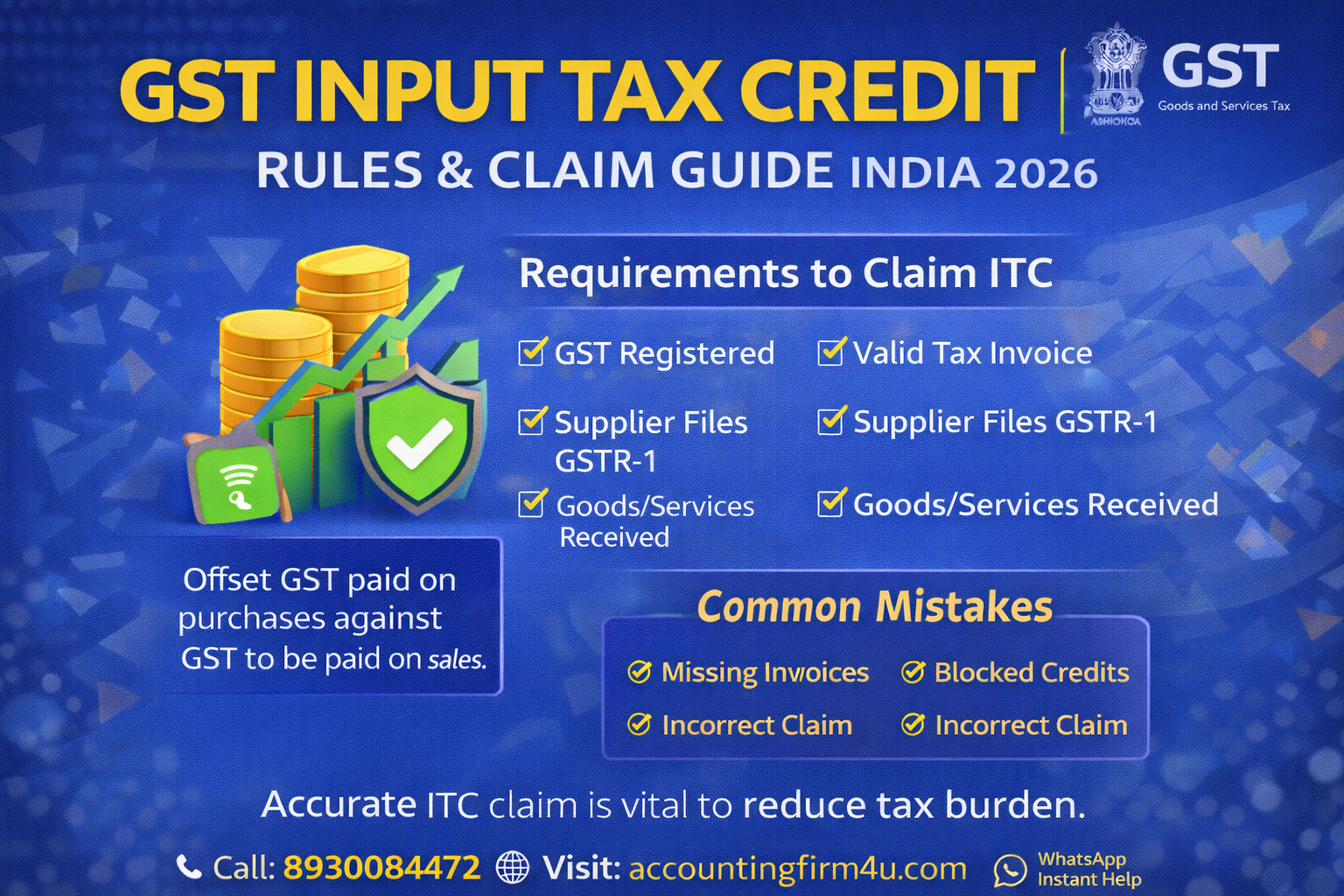
Input Tax Credit (ITC) is one of the most powerful benefits under GST. However, despite its importance, many businesses either fail to claim ITC properly or claim it incorrectly, which later results in notices and penalties. Therefore, understanding GST Input Tax Credit rules is essential for every registered taxpayer in India.
In this complete guide, we will explain what ITC is, eligibility conditions, documents required, blocked credits, reversal rules, and the correct process to claim ITC in 2026.
If you want professional help to avoid ITC errors, you can rely on our expert GST Return Filing Services in India for accurate reconciliation and filing.
What is GST Input Tax Credit (ITC)?
First and foremost, Input Tax Credit means that the GST paid on purchases can be reduced from the GST payable on sales.
For example:
- You collect ₹50,000 GST on sales
- You paid ₹30,000 GST on purchases
- You only pay ₹20,000 to the government
Thus, ITC prevents double taxation and reduces tax burden.
Basic Conditions to Claim ITC
Although ITC is beneficial, it is not automatic. Certain conditions must be satisfied.
1. You Must Be GST Registered
Only registered taxpayers can claim ITC.
2. You Must Have a Valid Tax Invoice
Without a proper GST invoice, ITC cannot be claimed.
3. Supplier Must File GSTR-1
If the supplier fails to upload invoice details, ITC may not reflect in GSTR-2B.
4. Goods/Services Must Be Received
ITC is allowed only after receiving goods or services.
5. Tax Must Be Paid to Government
If supplier does not pay tax, ITC claim may be restricted.
Therefore, compliance on both buyer and supplier side is essential.
ITC Appears in GSTR-2A and GSTR-2B
GSTR-2A and GSTR-2B are auto-generated statements showing purchase details.
However:
- GSTR-2A is dynamic
- GSTR-2B is static (recommended for ITC claim)
Consequently, businesses should reconcile their books with GSTR-2B before filing GSTR-3B.
If reconciliation becomes complex, professional GST Return Filing Services in India can help ensure accurate ITC claims.
Blocked ITC – Credits You Cannot Claim
Although ITC is widely available, certain expenses are not eligible.
Examples of Blocked Credits:
- Motor vehicles (with exceptions)
- Personal expenses
- Food and beverages
- Club memberships
- Construction of immovable property
Therefore, claiming ineligible ITC can trigger notices.
ITC Reversal Rules
Sometimes ITC must be reversed.
For example:
- If payment to supplier is not made within 180 days
- If goods are used for personal purpose
- If exempt supplies are involved
Consequently, periodic review of ITC is necessary.
Time Limit to Claim ITC
ITC must be claimed within prescribed time limits.
Generally, ITC for a financial year must be claimed before:
- 30th November of following financial year
OR - Date of filing annual return
Whichever is earlier.
Therefore, delaying ITC claim may result in permanent loss.
Common ITC Mistakes Businesses Make
Even experienced businesses make errors such as:
- Claiming ITC without invoice
- Not reconciling GSTR-2B
- Claiming blocked credit
- Missing ITC deadline
- Incorrect tax rate reporting
As a result, GST department may issue mismatch notices.
Thus, systematic reconciliation is extremely important.
ITC and GSTR-3B Connection
ITC is claimed in GSTR-3B.
However, ITC declared in GSTR-3B must match:
- GSTR-2B
- Books of accounts
Otherwise, discrepancies arise.
Therefore, reconciliation before filing is critical.
You can also understand the difference between GSTR-1 and GSTR-3B to ensure proper compliance.
Practical Steps to Claim ITC Correctly
Instead of guessing figures, follow this structured approach:
- Download GSTR-2B
- Compare with purchase register
- Identify mismatches
- Contact supplier for correction
- Claim eligible ITC in GSTR-3B
Additionally, maintain proper digital bookkeeping.
Impact of Wrong ITC Claim
If ITC is claimed incorrectly:
- Interest at 18% may apply
- ITC reversal required
- Penalty may be imposed
- GST notices may be issued
Consequently, incorrect ITC claim increases compliance risk.
Therefore, accuracy matters more than speed.
Why ITC Reconciliation is Important for Small Businesses
Small businesses often ignore ITC reconciliation due to limited accounting resources.
However:
- ITC directly affects profit margins
- Incorrect claim affects cash flow
- Mismatch leads to penalties
Thus, even small businesses should prioritize proper ITC management.
Frequently Asked Questions
1. Can ITC be claimed on capital goods?
Yes, if used for business purposes.
2. Can ITC be claimed without GSTR-2B reflection?
Generally, ITC must reflect in GSTR-2B to be eligible.
3. Is ITC available under Composition Scheme?
No, composition dealers cannot claim ITC.
Final Thoughts
To summarize, GST Input Tax Credit is a major financial benefit under the GST system. However, it requires proper documentation, supplier compliance, and monthly reconciliation.
Although ITC reduces tax burden, incorrect claims can result in serious penalties. Therefore, businesses must adopt a structured compliance approach.
Instead of risking ITC mismatches or notices, you can rely on experienced professionals for accurate filing and reconciliation.
If you need expert assistance, connect with us for reliable GST Return Filing Services in India today.
📞 Talk to a GST Expert
💬 WhatsApp for Instant Support
🌐 Visit: https://accountingfirm4u.com/