
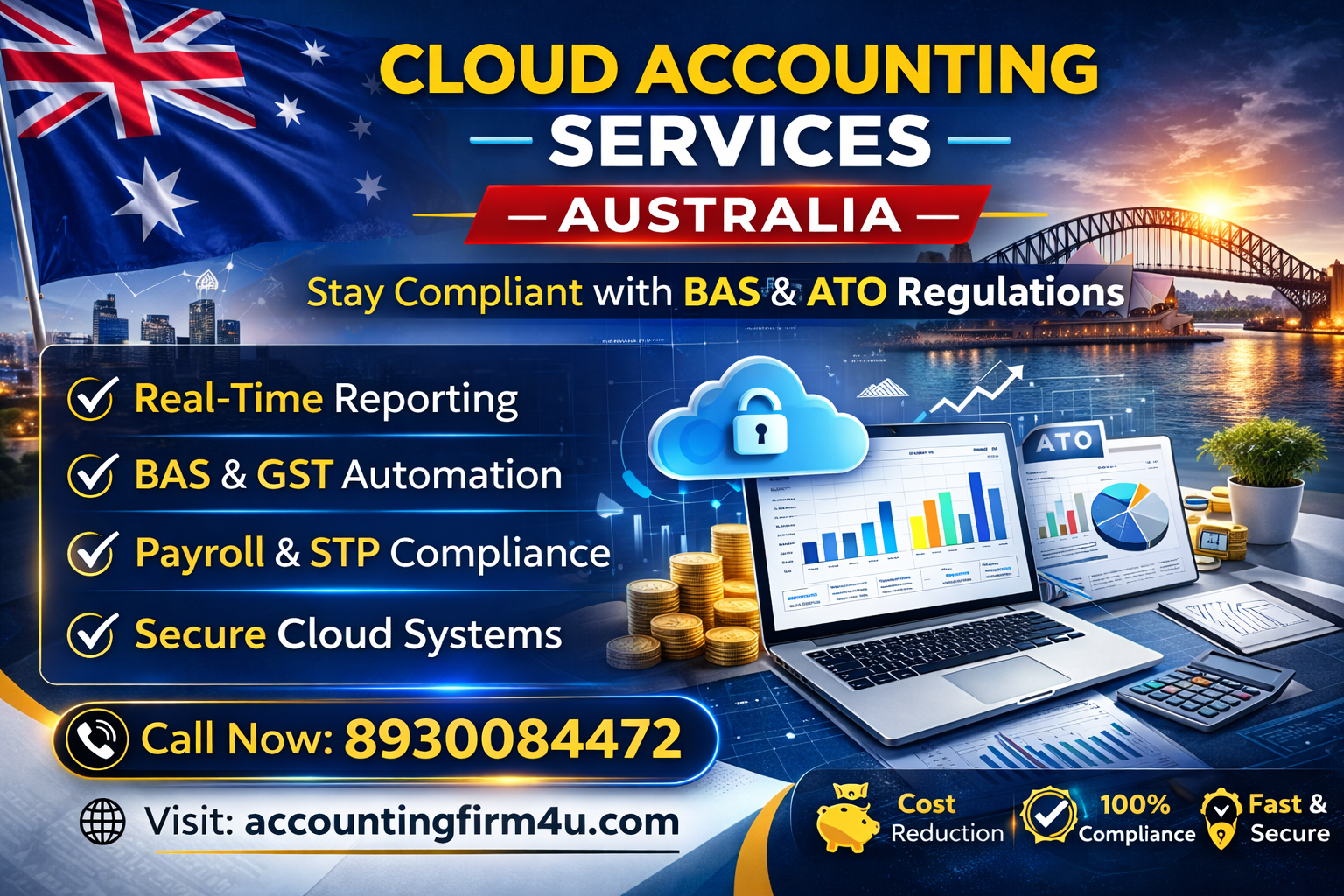
In today’s rapidly evolving digital economy, Australian businesses are constantly seeking smarter, faster, and more secure ways to manage their finances. While traditional accounting methods once dominated the industry, they are now being replaced by more efficient digital solutions. Consequently, cloud accounting has emerged as a transformative force across Australia.
As a result, many growing companies are now adopting Cloud Accounting Services Australia to improve compliance, automation, and real-time financial reporting.
Not only does cloud accounting improve accessibility, but it also enhances compliance, automation, and financial transparency. Therefore, businesses that adopt cloud-based systems gain a significant competitive advantage.
Let us explore how cloud accounting is revolutionizing Australian businesses in 2026.
What Is Cloud Accounting?
Cloud accounting refers to financial management software hosted online rather than installed on a local computer. Unlike traditional systems, cloud platforms allow users to access financial data anytime, anywhere.
Because data is stored securely in the cloud, business owners, accountants, and financial advisors can collaborate in real time. As a result, financial reporting becomes more transparent and efficient.
Moreover, cloud accounting platforms integrate with payroll systems, invoicing tools, inventory management software, and banking applications. Consequently, businesses enjoy seamless automation.
Why Australian Businesses Are Moving to Cloud Accounting
Over the past few years, Australia has experienced a strong push toward digital compliance. For example, the Australian Taxation Office (ATO) requires accurate digital reporting for BAS, GST, and payroll under Single Touch Payroll (STP).
Therefore, manual bookkeeping methods are no longer practical. Instead, cloud accounting ensures:
- Automated GST calculations
- Real-time BAS tracking
- Secure payroll processing
- Digital document storage
- Instant financial reporting
As a result, businesses can remain compliant without unnecessary stress.
Key Benefits of Cloud Accounting for Australian Businesses
1️⃣ Real-Time Financial Visibility
First and foremost, cloud accounting provides real-time financial dashboards. Instead of waiting until the end of the month, business owners can monitor income, expenses, and cash flow daily.
Consequently, decision-making becomes proactive rather than reactive.
2️⃣ Improved BAS & GST Compliance
Australia’s BAS reporting requirements demand accuracy and timely submission. However, manual processes increase the risk of errors.
Fortunately, cloud accounting software automates GST classification and prepares reports for BAS lodgement. Therefore, compliance becomes faster and more reliable.
3️⃣ Enhanced Collaboration
Because cloud systems are accessible remotely, accountants and business owners can collaborate seamlessly. This is especially beneficial for businesses operating across Sydney, Melbourne, Brisbane, and Perth.
Furthermore, professional firms often recommend businesses to Outsource Xero Accounting Services to combine cloud technology with expert financial management.
As a result, businesses receive professional oversight while benefiting from cloud automation.
4️⃣ Data Security & Backup
Data security is a top concern for Australian businesses. However, modern cloud platforms use encrypted servers, multi-factor authentication, and automated backups.
Consequently, financial records remain protected against cyber threats and accidental data loss.
5️⃣ Scalability for Growing Companies
As transaction volumes increase, traditional accounting systems may struggle to keep up. In contrast, cloud accounting easily scales with business growth.
Therefore, startups and SMEs can expand without worrying about accounting limitations.
Industries in Australia Benefiting from Cloud Accounting
Cloud accounting is particularly beneficial for:
- Construction & trade businesses
- E-commerce companies
- Professional service firms
- Healthcare providers
- Real estate agencies
- Technology startups
Because these industries manage high transaction volumes and regulatory compliance, cloud accounting provides clarity and efficiency.
Cost Advantages of Cloud Accounting
Hiring full-time accounting staff in Australia can be expensive due to salaries, superannuation, and office infrastructure costs.
However, cloud accounting reduces:
- Paperwork expenses
- Software maintenance costs
- IT infrastructure requirements
- Administrative overhead
Additionally, many businesses now prefer to Outsource Accounting Services in Australia to further reduce operational costs while maintaining professional accuracy.
Thus, cloud accounting combined with outsourcing becomes a powerful cost-saving strategy.
Cloud Accounting vs Traditional Accounting
| Feature | Traditional Accounting | Cloud Accounting |
|---|---|---|
| Accessibility | Office-based only | Anywhere access |
| Data Backup | Manual | Automatic |
| Compliance | Manual reporting | Automated GST/BAS |
| Collaboration | Limited | Real-time |
| Scalability | Restricted | Flexible |
Clearly, cloud accounting offers superior flexibility and efficiency.
Why 2026 Is the Right Time to Transition
Australia’s business environment is becoming increasingly digital. Moreover, government compliance requirements are stricter than ever.
Because of this shift:
- Automation reduces human error
- Digital records simplify audits
- Real-time insights improve forecasting
- Integration enhances productivity
Therefore, businesses that delay digital transformation risk falling behind competitors.
Common Myths About Cloud Accounting
Despite its benefits, some misconceptions still exist.
Myth 1: Cloud Systems Are Not Secure
In reality, reputable cloud providers use bank-level encryption and advanced cybersecurity protocols.
Myth 2: It Is Too Complicated
However, modern platforms are user-friendly and supported by professional accountants.
Therefore, many Australian businesses prefer to Outsource Xero Accounting Services to ensure accurate BAS reporting and expert-managed financial systems.
Myth 3: It Is Only for Large Corporations
On the contrary, small businesses benefit the most due to cost savings and automation.
Final Thoughts
In conclusion, cloud accounting is not just a technological upgrade—it is a strategic necessity for Australian businesses in 2026. Not only does it enhance compliance with ATO regulations, but it also improves efficiency, transparency, and scalability.
Therefore, businesses looking to stay competitive should consider adopting cloud accounting solutions alongside professional outsourced support.
By combining automation with expert oversight, Australian companies can streamline operations, reduce costs, and focus confidently on growth.
📲 Discuss Your Requirements on WhatsApp : +91-8930084472
🌐 Explore Services on Our Website
📞 Call Now for Free Consultation