In Australia’s highly regulated business environment, payroll management is no longer just about paying employees on time. Instead, it has become a critical compliance function directly connected to the Australian Taxation Office (ATO). With the implementation of Single Touch Payroll (STP), businesses must now report payroll information digitally each pay cycle. Therefore, ensuring accurate payroll and STP compliance is essential in 2026.
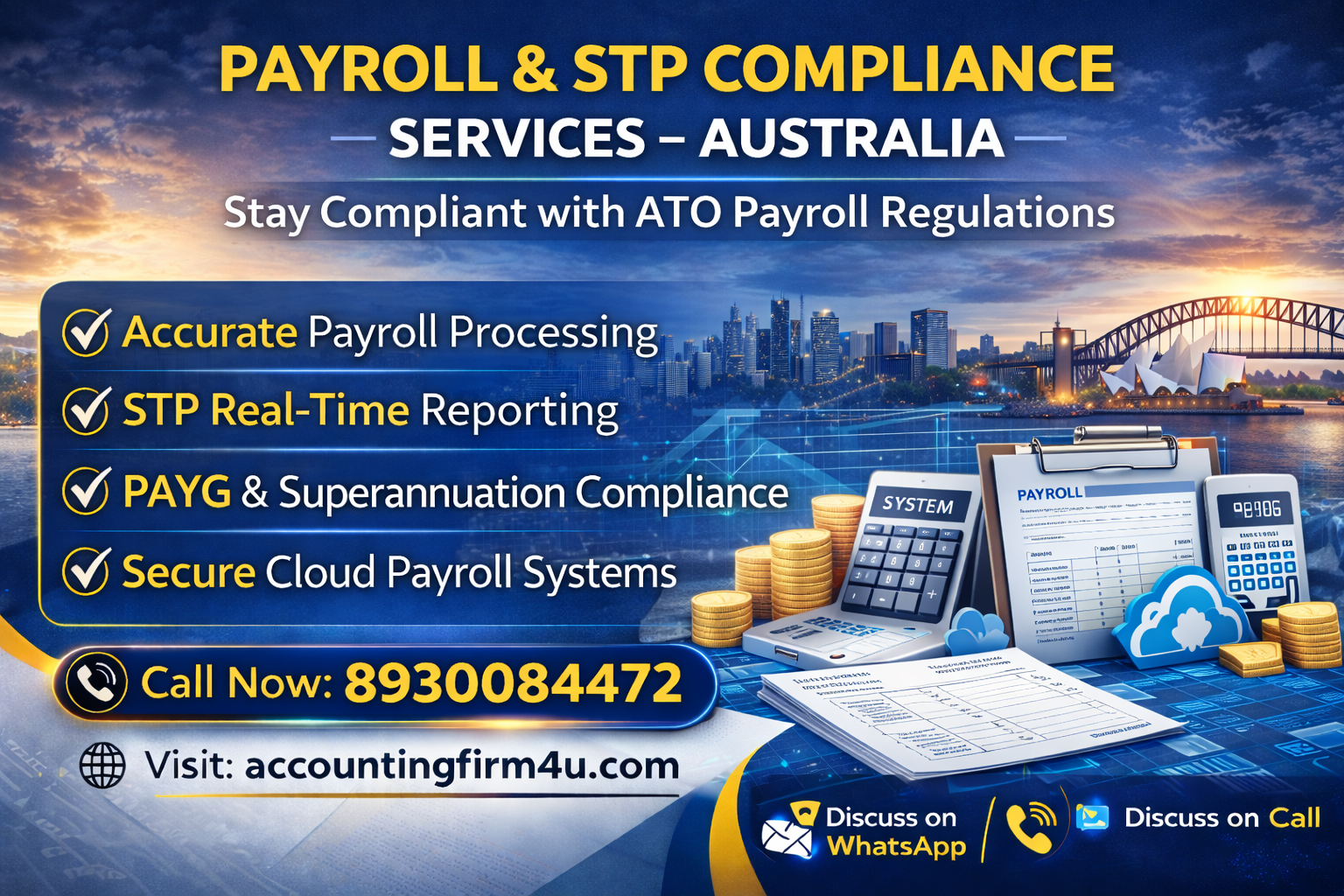
To avoid penalties and ensure accurate reporting, many SMEs now rely on Payroll & STP Compliance Services Australia for professional payroll management.
Not only does proper payroll management protect businesses from penalties, but it also improves transparency, employee trust, and financial accuracy. As a result, many Australian businesses are now outsourcing payroll services to ensure full compliance and operational efficiency.
Let us explore why payroll and STP compliance should be a top priority.
Understanding Payroll & STP Compliance in Australia
Single Touch Payroll (STP) is an ATO reporting system requiring employers to send employee salary, PAYG withholding, and superannuation information directly to the ATO every pay cycle.
Consequently, payroll errors are immediately visible to regulatory authorities. Furthermore, incorrect reporting can trigger penalties, audits, or compliance notices.
Therefore, businesses must ensure:
- Accurate PAYG withholding calculations
- Correct superannuation contributions
- Timely reporting each pay cycle
- Secure employee data management
Because of this digital reporting system, manual payroll processes are no longer sufficient.
Why Payroll Compliance Is Becoming More Complex
Over time, payroll regulations in Australia have become increasingly detailed. For example:
- Award wage compliance requirements
- Superannuation guarantee obligations
- Leave entitlements tracking
- Fair Work regulations
- PAYG withholding updates
Moreover, businesses operating across different states must understand varying employment conditions.
As a result, payroll management demands specialized expertise.
Risks of Managing Payroll In-House
Although some businesses attempt to handle payroll internally, several risks arise.
1️⃣ Calculation Errors
Even minor payroll mistakes can result in underpayment or overpayment issues, leading to legal complications.
2️⃣ Late STP Reporting
Because STP requires real-time reporting, delays may attract ATO scrutiny.
3️⃣ Superannuation Compliance Risks
Incorrect superannuation contributions can lead to penalties and interest charges.
4️⃣ Data Security Concerns
Payroll data contains sensitive employee information. Therefore, secure systems are essential.
Consequently, outsourcing payroll services becomes a practical and strategic solution.
Benefits of Outsourcing Payroll & STP Services
✅ 1. Guaranteed Compliance
Professional payroll experts stay updated with ATO, Fair Work, and superannuation regulations. Therefore, reporting errors are minimized.
✅ 2. Automated Cloud Reporting
Cloud accounting systems integrate seamlessly with payroll software. In fact, many companies prefer to Outsource Xero Accounting Services to automate payroll, PAYG, and STP compliance.
As a result, payroll becomes accurate and efficient.
✅ 3. Reduced Administrative Burden
Outsourcing eliminates the need for in-house payroll staff. Consequently, management can focus on strategic business growth.
✅ 4. Improved Employee Confidence
Accurate and timely salary payments enhance employee trust and morale.
✅ 5. Cost Efficiency
Hiring payroll specialists internally can be expensive. However, outsourcing provides expert service at a lower operational cost.
Industries That Require Strong Payroll Compliance
Payroll compliance is especially critical for:
- Construction & trade businesses
- Hospitality & retail
- Healthcare providers
- Professional services firms
- Technology startups
- Manufacturing companies
Because these industries manage large or diverse workforces, accurate payroll systems are essential.
How Payroll Compliance Impacts Financial Planning
Payroll expenses are often a company’s largest cost component. Therefore, accurate payroll reporting directly impacts budgeting and forecasting.
Professional payroll management provides:
- Clear wage expense tracking
- Accurate PAYG forecasting
- Superannuation liability planning
- Employee benefit calculations
As a result, businesses gain better financial control.
Why 2026 Demands Digital Payroll Systems
Australia continues to move toward digital tax administration. Furthermore, ATO systems rely heavily on real-time reporting and automated data matching.
Because of this shift:
- Manual payroll increases compliance risks
- Digital errors are quickly detected
- Accurate STP reporting is mandatory
- Secure data storage is critical
Therefore, businesses must adopt cloud-based payroll solutions combined with professional oversight.
Common Myths About Payroll Outsourcing
Myth 1: It Reduces Control
On the contrary, cloud dashboards provide real-time access to payroll data.
Myth 2: It Is Only for Large Companies
However, SMEs benefit significantly because they lack internal HR departments.
Myth 3: It Is Expensive
In reality, outsourcing reduces salary, software, and training costs.
Final Thoughts
In conclusion, payroll and STP compliance is no longer optional for Australian businesses—it is a legal obligation. With increasing digital monitoring from the ATO, businesses must ensure accurate, timely, and secure payroll reporting.
Therefore, outsourcing payroll services offers a strategic advantage. Not only does it reduce compliance risks, but it also improves efficiency, employee satisfaction, and financial clarity.
By partnering with experienced accounting professionals, Australian businesses can confidently manage payroll obligations while focusing on growth and long-term success.