
Introduction
Accounting is the language of business. Every company—small or large—depends on accounting to track income, control expenses, and comply with tax laws. Therefore, understanding accounting is not only important for businesses but also highly valuable for students and job seekers.
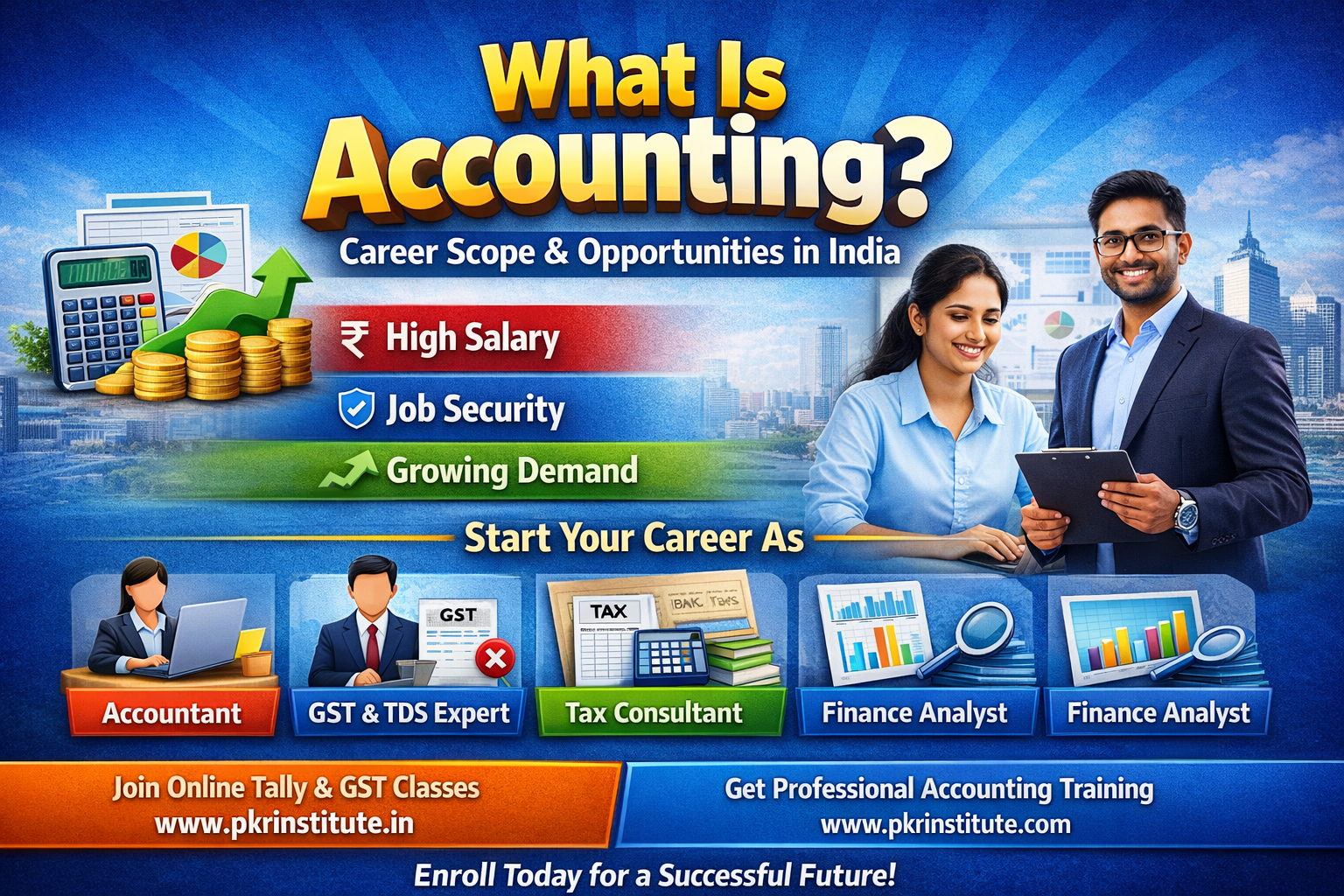
Moreover, with the rapid growth of GST, digital compliance, and cloud accounting, the demand for skilled accountants in India is increasing every year. Consequently, accounting has become one of the most stable and rewarding career options today.
In this article, you will learn what accounting is, its types, career scope, salary structure, and how you can start a successful accounting career.
What Is Accounting?
Accounting is the systematic process of recording, classifying, summarising, and analysing financial transactions of a business. In simple words, accounting tells a business:
- How much money is coming in
- How much money is going out
- Whether the business is in profit or loss
Furthermore, accounting helps businesses comply with GST, Income Tax, TDS, and statutory laws. As a result, accountants play a crucial role in decision-making and legal compliance.
Types of Accounting
Accounting is broadly divided into several categories. Therefore, understanding these types helps you choose the right career path.
1️⃣ Financial Accounting
This focuses on preparing financial statements such as:
- Profit & Loss Account
- Balance Sheet
- Cash Flow Statement
These reports are mainly used by owners, investors, and banks.
2️⃣ Management Accounting
Management accounting helps business owners make strategic decisions. It includes:
- Budgeting
- Cost analysis
- Forecasting
Hence, management accountants support internal planning and growth.
3️⃣ Tax Accounting
Tax accounting deals with:
- GST compliance
- Income tax returns
- TDS returns
Due to frequent changes in tax laws, tax accountants are always in demand.
4️⃣ Cost Accounting
Cost accounting helps businesses control expenses and improve profitability. Therefore, it is widely used in manufacturing and production industries.
Why Accounting Is a High-Demand Career in India
Accounting is considered a recession-proof career. Even during economic slowdowns, businesses still require accountants to manage finances and comply with laws.
Moreover:
- GST has increased demand for trained professionals
- Digital accounting software like Tally and cloud tools are widely used
- Startups and SMEs are growing rapidly
As a result, skilled accountants never remain unemployed.
Career Scope in Accounting
After learning accounting, you can work in multiple roles, such as:
- Accountant
- GST Executive
- TDS Consultant
- Accounts Executive
- Finance Analyst
- Tax Consultant
Additionally, you can work in:
- CA firms
- Corporates
- Startups
- Manufacturing companies
- Freelance accounting services
Therefore, accounting offers both job security and flexibility.
Salary of an Accountant in India
Salary depends on skills, experience, and practical knowledge.
| Experience Level | Monthly Salary |
|---|---|
| Fresher | ₹15,000 – ₹25,000 |
| 2–3 Years | ₹30,000 – ₹50,000 |
| 5+ Years | ₹60,000 – ₹1,00,000+ |
However, candidates with practical GST, TDS & Tally knowledge earn faster increments.
Skills Required to Become an Accountant
To succeed in accounting, you should focus on:
- Practical accounting knowledge
- GST & TDS compliance
- Tally Prime software
- Excel for accounting
- Understanding of tax laws
Therefore, theoretical knowledge alone is not enough. Practical training is essential.
How to Start an Accounting Career (Step-by-Step)
If you are a student, graduate, or working professional, follow these steps:
Step 1: Learn Accounting Basics
Understand debit-credit rules, journal entries, and financial statements.
Step 2: Get Practical Training
Enroll in job-oriented accounting courses that include live projects and real filings.
👉 Recommended: Online Accounting, Tally, GST & TDS Training available at
🔗 pkrinstitute.in (Free demo classes available)
Step 3: Practice on Software
Learn Tally Prime, GST portal, and Excel, as companies prefer hands-on professionals.
Step 4: Prepare for Interviews
Practice real-world interview questions related to GST, TDS, and compliance.
👉 For professional-level training and certifications, explore
🔗 pkrinstitute.com
Why Practical Accounting Training Matters
Many students struggle to get jobs because they only have theoretical knowledge. However, companies expect accountants who can:
- File GST returns
- Handle TDS deductions
- Prepare balance sheets
- Work independently
Therefore, professional accounting training increases job placement chances by 3x.
Final Thoughts
Accounting is not just about numbers—it is about business growth, compliance, and decision-making. Moreover, it offers long-term stability, attractive salary growth, and multiple career options.
If you want a secure and high-demand career, accounting is the right choice. However, success depends on practical skills and continuous learning.
🎯 Start your accounting journey today with expert-led practical training and build a future-proof career.