
Introduction
Many students and even working professionals often confuse accounting, bookkeeping, and auditing. Although these terms are related, they are not the same. Therefore, understanding the difference is essential if you are planning a career in finance or accounting.
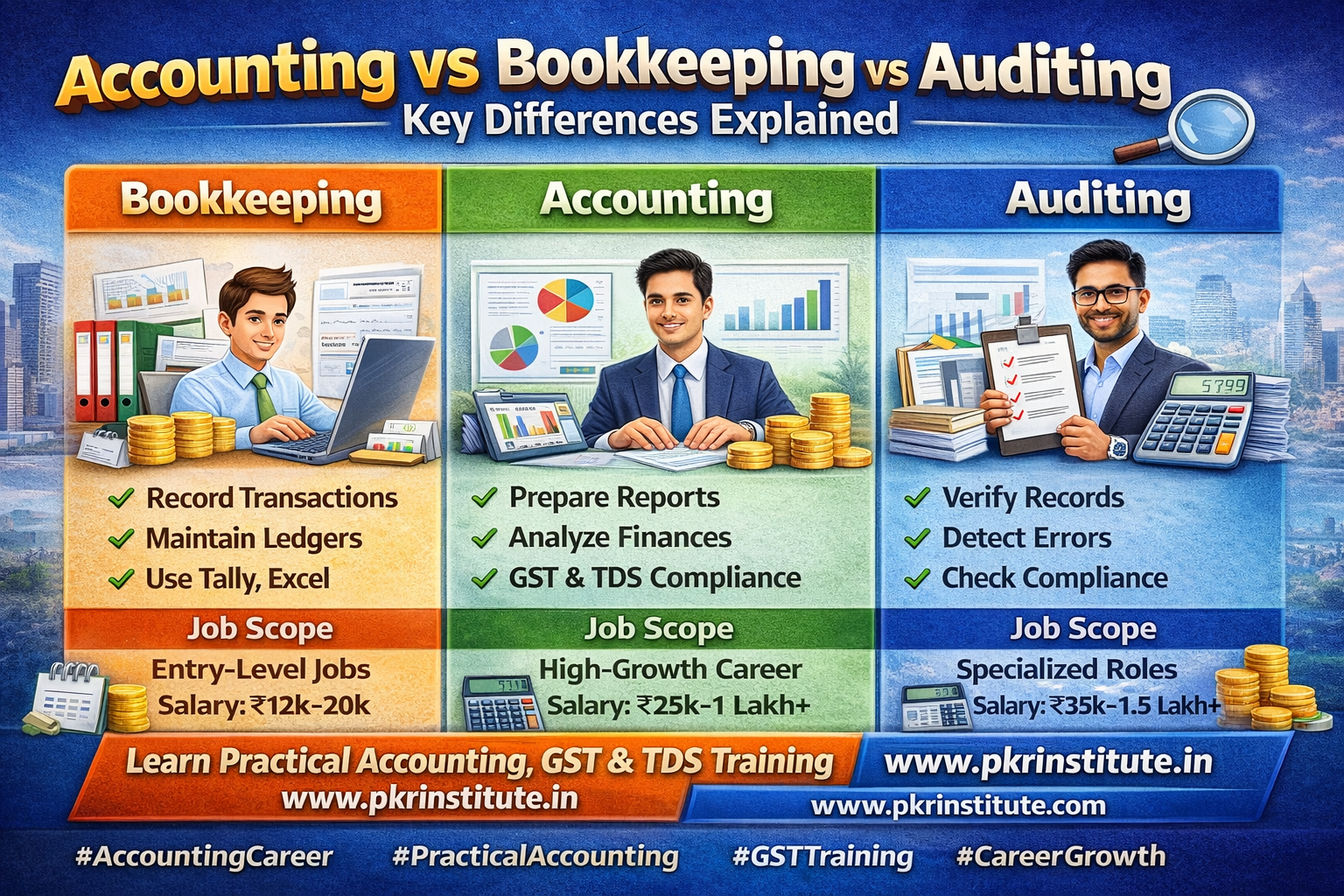
Moreover, companies clearly define these roles while hiring. As a result, knowing which skill belongs to which role can significantly improve your job opportunities. In this article, we will explain accounting vs bookkeeping vs auditing in a simple, practical, and career-oriented manner.
What Is Bookkeeping?
Bookkeeping is the foundation of accounting. It mainly focuses on recording daily financial transactions of a business.
Key Functions of Bookkeeping
- Recording sales and purchase entries
- Maintaining cash book & bank book
- Recording expenses and income
- Maintaining invoices and bills
In other words, bookkeeping answers the question:
👉 “What transactions happened today?”
Furthermore, bookkeeping is usually done using Tally Prime, Excel, or accounting software.
What Is Accounting?
Accounting is a broader concept than bookkeeping. It not only records data but also analyses and interprets financial information.
Key Functions of Accounting
- Preparing Profit & Loss Account
- Preparing Balance Sheet
- GST & TDS compliance
- Financial analysis and reporting
Therefore, accounting answers the question:
👉 “What do these numbers mean for the business?”
Additionally, accounting helps business owners make financial decisions and comply with tax laws.
What Is Auditing?
Auditing is the process of verifying and examining accounting records to ensure accuracy and compliance.
Key Functions of Auditing
- Checking correctness of accounts
- Ensuring compliance with laws
- Detecting errors and fraud
- Providing audit reports
Hence, auditing answers the question:
👉 “Are the accounts prepared correctly?”
Auditing is usually performed by independent professionals or audit firms.
Accounting vs Bookkeeping vs Auditing – Quick Comparison
| Basis | Bookkeeping | Accounting | Auditing |
|---|---|---|---|
| Nature | Recording | Analysis & Reporting | Verification |
| Focus | Daily transactions | Financial statements | Accuracy & compliance |
| Skill Level | Basic | Advanced | Expert |
| Software | Tally, Excel | Tally, GST, IT tools | Audit tools |
| Career Level | Entry-level | Mid to senior | Senior / CA level |
Career Scope of Bookkeeping
Bookkeeping is ideal for freshers and beginners.
Job Roles
- Junior Bookkeeper
- Accounts Assistant
- Data Entry Operator (Accounts)
Salary Range
₹12,000 – ₹20,000 per month (fresher)
However, bookkeeping alone has limited growth unless combined with accounting skills.
Career Scope of Accounting
Accounting offers excellent career growth and stability.
Job Roles
- Accountant
- GST Executive
- TDS Executive
- Accounts Manager
Salary Range
- Fresher: ₹15,000 – ₹25,000
- Experienced: ₹40,000 – ₹1,00,000+
Therefore, accounting is one of the most in-demand skills in India.
👉 You can start practical accounting, GST & TDS training with live projects at
🔗 pkrinstitute.in (Free demo available)
Career Scope of Auditing
Auditing is more specialised and requires strong accounting knowledge.
Job Roles
- Audit Executive
- Internal Auditor
- Statutory Auditor
Salary Range
₹35,000 – ₹1,50,000+ (experience-based)
Auditing is often pursued by CA, semi-qualified CA, or experienced accountants.
Which Is Best for You?
Choosing the right option depends on your goal:
- Beginner / Student → Start with Bookkeeping + Accounting
- Job-Oriented Candidate → Practical Accounting with GST & TDS
- Professional Growth → Accounting + Auditing exposure
However, employers today prefer candidates who have practical accounting knowledge, not just theory.
👉 For professional-level accounting training, certifications, and career guidance, visit
🔗 pkrinstitute.com
Why Practical Training Is Important
Many candidates know definitions but fail in jobs because they lack hands-on experience. On the other hand, trained professionals can:
- File GST returns independently
- Handle TDS compliance
- Prepare final accounts
- Face interviews confidently
As a result, practical training increases placement chances significantly.
Final Conclusion
Although bookkeeping, accounting, and auditing are interconnected, they serve different purposes. Therefore, understanding their differences helps you choose the right career path.
If you want job security, growth, and high demand, accounting with practical GST & TDS knowledge is the best option. Moreover, continuous learning will ensure long-term success in this field.
🎯 Start learning today and build a strong accounting career.