
When starting a new business, GST registration is one of the most important compliance steps. However, many applicants face delays or rejection simply because they submit incorrect or incomplete documents. Therefore, understanding the exact documents required for GST registration is crucial before applying online.
In this detailed guide, we will explain the complete document checklist, category-wise requirements, common mistakes, and practical tips to ensure smooth approval in 2026.
If you prefer professional guidance instead of handling documentation alone, you can rely on our expert GST Return Filing Services in India for hassle-free registration and compliance support.
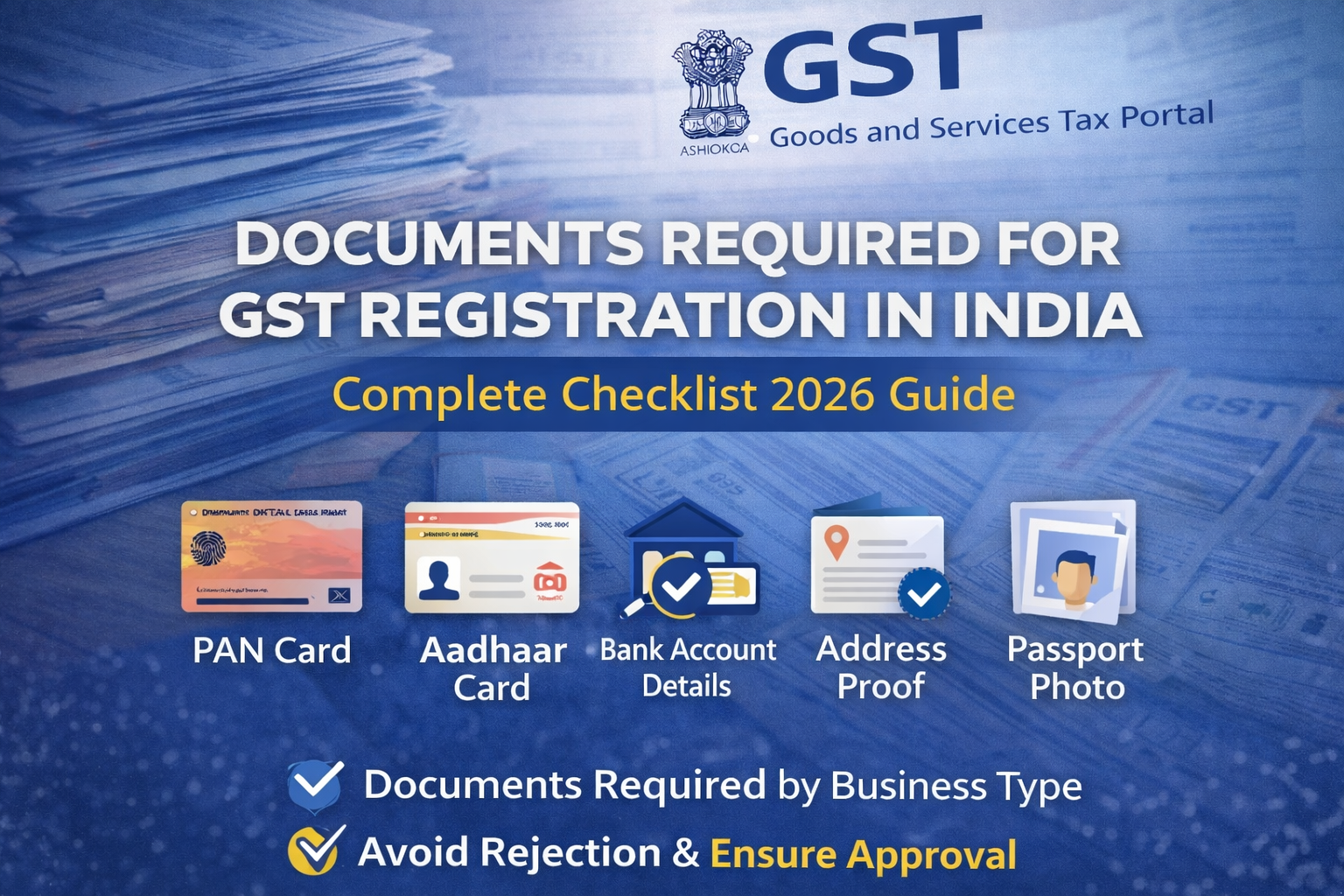
Why Proper Documentation is Important for GST Registration
First and foremost, GST registration is a document-driven process. The GST officer verifies all details based on submitted proofs. Consequently, even minor mismatches can lead to application rejection or delay.
Moreover, incorrect documentation may trigger queries from the GST department, which can extend approval timelines. Therefore, preparing accurate documents beforehand significantly increases approval chances.
Basic Documents Required for GST Registration
Although requirements vary depending on business type, certain documents are mandatory for almost all applicants.
1. PAN Card
PAN is mandatory for GST registration. In fact, GST registration cannot proceed without a valid PAN.
- Proprietorship → PAN of proprietor
- Partnership → PAN of firm
- Company/LLP → PAN of company
Therefore, ensure PAN details match exactly with official records.
2. Aadhaar Card
Although Aadhaar is not compulsory in every case, Aadhaar authentication speeds up approval.
Additionally, Aadhaar verification reduces the chances of physical verification by the GST officer.
3. Business Address Proof
Business address proof is one of the most commonly rejected documents. Therefore, it must be clear and valid.
Accepted documents include:
- Electricity bill
- Property tax receipt
- Rent agreement
- NOC from property owner
- Municipal khata copy
However, the document must not be outdated. Generally, utility bills should not be older than 2–3 months.
4. Bank Account Details
Applicants must submit:
- Cancelled cheque
OR - Bank statement
The bank account must be in the business name. Otherwise, clarification may be required.
5. Passport-Size Photograph
Recent passport-size photographs of the authorized signatory are required. Although this may seem minor, unclear or outdated photos can cause issues.
Documents Required Based on Business Type
Although the above documents are common, additional documents depend on your business structure.
🧾 Proprietorship Firm
For proprietorship, the following are required:
- PAN of proprietor
- Aadhaar card
- Address proof
- Bank account details
Since proprietorship and owner are legally the same, documentation is relatively simple.
🤝 Partnership Firm
In addition to basic documents, partnership firms must submit:
- Partnership deed
- PAN of firm
- Identity & address proof of partners
- Authorization letter for signatory
Therefore, ensure that the partnership deed is properly signed and stamped.
🏢 Private Limited Company / LLP
For companies and LLPs, documentation is more detailed.
Required documents include:
- Certificate of Incorporation
- PAN of company
- Memorandum of Association (MOA)
- Articles of Association (AOA)
- Board resolution authorizing signatory
- Digital Signature Certificate (DSC)
Moreover, DSC is mandatory for companies and LLPs during verification.
🛒 E-Commerce Sellers
Even if turnover is below threshold, e-commerce sellers must register under GST.
In addition to standard documents, platform details may be required.
Additional Documents in Special Cases
In certain situations, extra documentation may be needed.
If Business Premises Are Rented
- Rent agreement
- NOC from landlord
- Utility bill of property owner
If Business Operates from Home
- Electricity bill in owner’s name
- NOC from property owner
If Using Shared Office
- Consent letter
- Address proof
- Agreement copy
Therefore, documentation depends significantly on business premises type.
Common Mistakes That Cause GST Application Rejection
Although GST registration is fully online, mistakes are very common. For example:
- Mismatch between PAN and Aadhaar details
- Incorrect business activity selection
- Blurred document uploads
- Expired address proof
- Bank details mismatch
As a result, applicants may receive notices seeking clarification.
Therefore, reviewing documents carefully before submission is essential.
How to Prepare Documents for Smooth Approval
Instead of rushing through the process, follow these steps:
1. Verify PAN & Aadhaar Details
Ensure that name, date of birth, and other details match exactly.
2. Upload Clear Scanned Copies
Blurry or cropped documents often lead to rejection.
3. Keep Utility Bills Recent
Use latest electricity or water bills.
4. Double-Check Bank Details
Account number and IFSC code must match official records.
5. Use Professional Assistance
Many businesses prefer expert support to eliminate compliance errors. In fact, professional guidance reduces rejection risk significantly.
You can explore our reliable GST Return Filing Services in India for smooth registration and ongoing compliance support.
How Long Does GST Registration Approval Take?
If documents are correct, approval typically takes 3–7 working days. However, if clarification is requested, timelines may extend.
Therefore, submitting complete documentation at the first attempt saves valuable time.
Is Digital Signature Mandatory?
Digital Signature Certificate (DSC) is mandatory for:
- Companies
- LLPs
However, proprietorship and partnership firms can use Aadhaar-based verification instead.
What Happens After GST Registration?
Many applicants believe documentation ends after approval. However, post-registration compliance is equally important.
After receiving GSTIN, businesses must:
- File monthly or quarterly returns
- Maintain proper invoices
- Reconcile ITC
- Pay tax on time
Therefore, documentation is just the beginning of ongoing compliance responsibility.
Frequently Asked Questions
1. Is GST registration free?
Yes, government does not charge fees. However, professional service charges may apply.
2. Can GST registration be done without bank account?
No. Bank account details are mandatory.
3. What if documents are incorrect?
GST officer may issue a notice asking for correction.
4. Can GST registration be cancelled later?
Yes, if business operations stop or eligibility criteria change.
Final Thoughts
To summarize, submitting correct documents is the foundation of successful GST registration. Although the online process appears simple, documentation errors often lead to rejection and delay.
Therefore, preparing a complete checklist beforehand ensures faster approval and smoother compliance.
Moreover, since GST compliance continues even after registration, maintaining proper records and filing returns on time is equally important.
If you want error-free GST registration and ongoing compliance support, connect with our team for professional GST Return Filing Services in India today.
📞 Talk to a GST Expert
💬 WhatsApp for Instant Assistance
📩 Book Your Free Consultation