
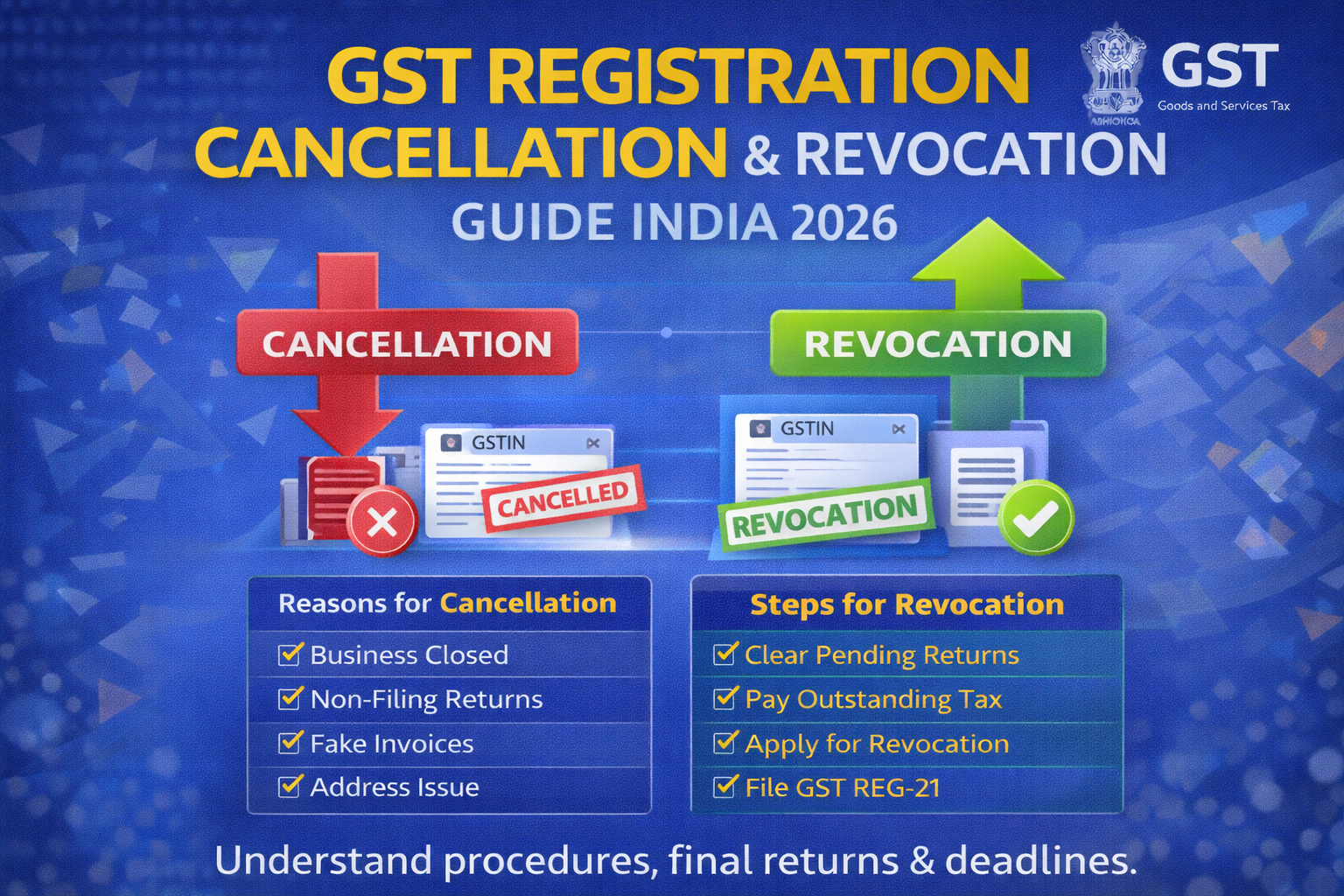
GST registration is mandatory for eligible businesses in India. However, there are situations where a business may need to cancel its GST registration. Similarly, in some cases, the GST department may cancel a registration due to non-compliance. Therefore, understanding the GST registration cancellation and revocation process is extremely important for every taxpayer.
In this detailed 2026 guide, we will explain voluntary cancellation, compulsory cancellation, revocation steps, required forms, deadlines, penalties, and compliance tips.
If you need professional support at any stage, you can rely on our expert GST Return Filing Services in India to ensure smooth and stress-free compliance.
What is GST Registration Cancellation?
First and foremost, GST registration cancellation means that a taxpayer’s GSTIN (Goods and Services Tax Identification Number) is officially deactivated. Once cancelled, the business is no longer considered a registered GST taxpayer.
As a result:
- You cannot collect GST from customers
- You cannot issue tax invoices
- You cannot claim Input Tax Credit (ITC)
- You must stop filing regular GST returns
Therefore, cancellation should be done carefully and only after evaluating business needs.
Types of GST Registration Cancellation
Broadly speaking, GST registration can be cancelled in two ways:
- Voluntary cancellation (by taxpayer)
- Compulsory cancellation (by GST department)
Let us understand both in detail.
1️⃣ Voluntary GST Registration Cancellation
A taxpayer can apply for cancellation voluntarily under certain circumstances.
For example:
- Business has been discontinued
- Business has been transferred or merged
- Change in constitution (e.g., proprietorship to company)
- Turnover falls below threshold limit
- Business is permanently closed
However, before applying, it is mandatory to file all pending GST returns and clear outstanding dues.
Consequently, proper compliance history is required before approval.
2️⃣ Compulsory Cancellation by GST Officer
On the other hand, the GST department may cancel registration if serious non-compliance is observed.
Common reasons include:
- Continuous non-filing of GST returns
- Fraudulent ITC claims
- Fake invoice transactions
- Business not operating from declared address
- Violation of GST rules
In such cases, a show-cause notice is issued. If the taxpayer fails to respond properly, registration may be cancelled.
Therefore, regular compliance is critical to avoid compulsory cancellation.
Step-by-Step Process for GST Registration Cancellation
Now let us understand the online process in detail.
Step 1: Login to GST Portal
Visit the official GST portal and log in using your GSTIN credentials.
Step 2: Navigate to Cancellation Application
Go to:
Services → Registration → Application for Cancellation of Registration
Step 3: Fill Form GST REG-16
Provide:
- Reason for cancellation
- Date of cessation of business
- Details of stock
- ITC reversal details
At this stage, accuracy is extremely important.
Step 4: Submit Application
After submission, an ARN (Application Reference Number) is generated.
Step 5: GST Officer Review
If documents and compliance are correct, cancellation order is issued in Form GST REG-19.
Generally, approval may take 7 to 30 working days.
Filing Final Return After Cancellation
Even after cancellation approval, compliance does not end immediately.
The taxpayer must file:
GSTR-10 (Final Return)
This return must be filed within 3 months from:
- Date of cancellation order
OR - Date of cancellation
Whichever is later.
Failure to file GSTR-10 may result in penalties.
What is GST Registration Revocation?
Revocation means restoring a cancelled GST registration.
However, revocation is allowed only if:
- Registration was cancelled by GST officer
- Taxpayer clears pending compliance
Voluntary cancellation cannot be revoked.
Therefore, revocation is mainly applicable in cases of compulsory cancellation.
Time Limit for Revocation
An application for revocation must be filed within:
30 days from the date of cancellation order.
Although extensions may be granted in certain cases, acting quickly is advisable.
Revocation Process – Step-by-Step
Let us examine the procedure:
Step 1: File All Pending Returns
Before applying, all pending returns must be filed.
Step 2: Pay Outstanding Tax, Interest & Penalty
All dues must be cleared completely.
Step 3: File Form GST REG-21
Submit revocation application online.
Step 4: Officer Review & Approval
If satisfied, the officer restores registration through Form GST REG-22.
Thus, full compliance is necessary before approval.
If handling notices or revocation becomes complex, professional GST Return Filing Services in India can help manage the process efficiently.
Common Mistakes Leading to Cancellation
Although GST compliance is structured, many businesses still make errors such as:
- Ignoring GST notices
- Delaying GSTR-3B filing
- Claiming excess ITC
- Not maintaining proper records
- Filing NIL returns repeatedly
As a result, the GST department may initiate cancellation proceedings.
Therefore, preventive compliance is better than corrective action.
Financial Impact of GST Cancellation
GST registration cancellation can seriously affect business operations.
For instance:
- Customers may refuse to deal with unregistered businesses
- Business credibility decreases
- Supply chain may be disrupted
- Legal complications may arise
Consequently, businesses should avoid cancellation due to negligence.
Practical Compliance Tips to Avoid Cancellation
Instead of waiting for notices, follow these steps:
- File returns before due dates
- Reconcile ITC regularly
- Maintain updated business address records
- Respond to notices promptly
- Seek professional guidance when needed
Moreover, keeping systematic accounting records reduces compliance risk significantly.
Frequently Asked Questions (FAQs)
1. Can GST registration be cancelled without filing pending returns?
No. All pending returns must be filed before cancellation approval.
2. Is there any government fee for cancellation?
There is no cancellation fee. However, tax dues must be cleared.
3. Can a business reapply for GST after cancellation?
Yes, fresh registration can be applied if eligibility conditions are satisfied.
4. What happens if cancellation notice is ignored?
The department may permanently cancel registration and impose penalties.
Final Thoughts
To summarize, GST registration cancellation and revocation are serious compliance matters. While voluntary cancellation may be necessary in certain cases, compulsory cancellation due to non-compliance can severely impact business stability.
Therefore, timely GST return filing, proper ITC reconciliation, and notice handling are essential for maintaining active registration.
Instead of risking penalties, notices, or cancellation, businesses should adopt a structured compliance strategy.
If you require professional assistance for cancellation, revocation, or ongoing compliance, connect with us for trusted GST Return Filing Services in India today.
📞 Talk to a GST Expert
💬 WhatsApp for Instant Support
🌐 Visit: https://accountingfirm4u.com/