
Receiving a GST notice can be stressful for any business owner. However, it is important to understand that not every GST notice means penalty or fraud. In many cases, notices are issued due to mismatches, delayed returns, or documentation errors. Therefore, knowing how to reply to GST notice online is crucial for maintaining compliance and avoiding penalties.
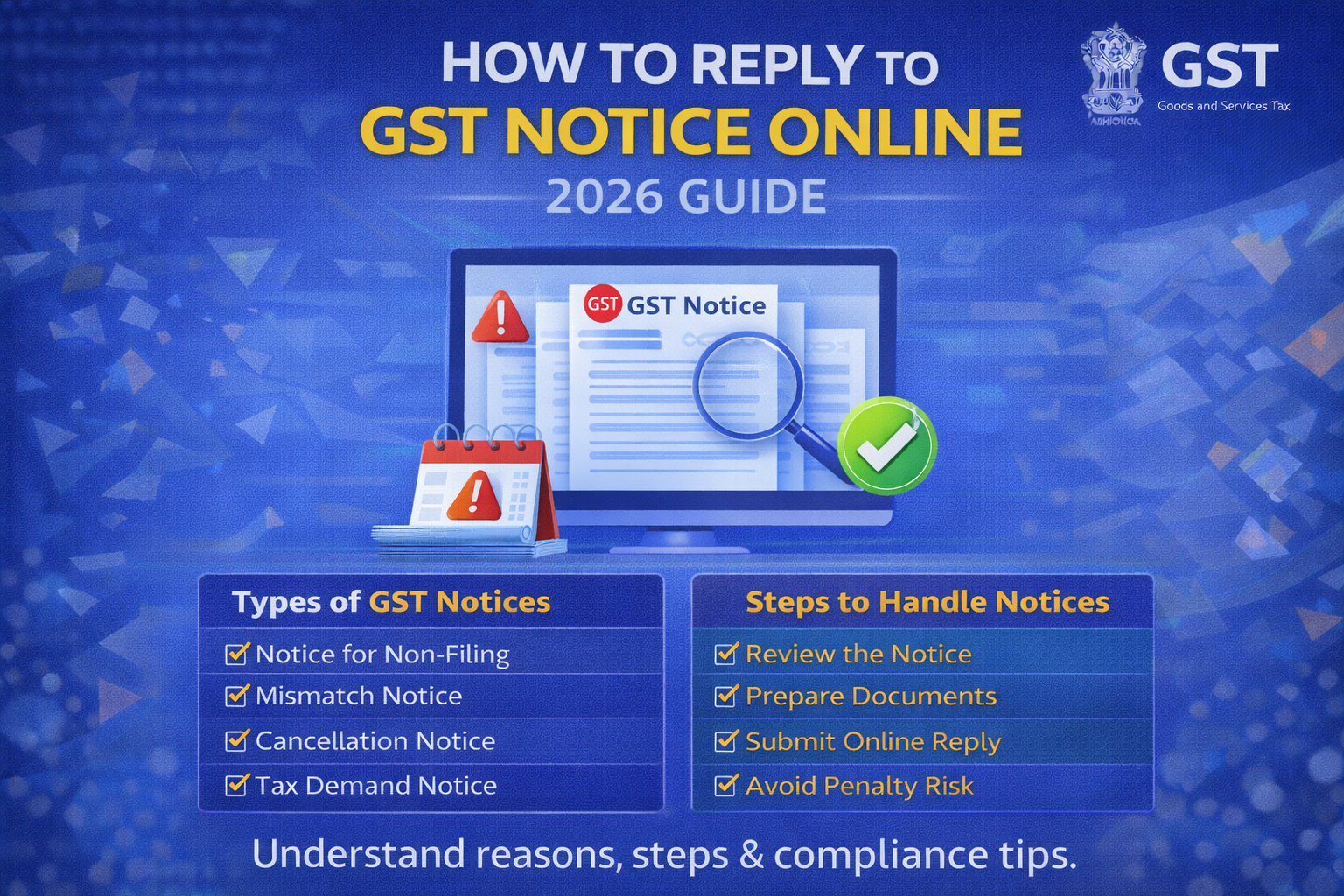
In this complete 2026 guide, we will explain types of GST notices, reasons for receiving notice, step-by-step reply process, required documents, and practical tips to handle notices professionally.
If you need expert assistance, you can rely on our trusted GST Return Filing Services in India to manage notice replies accurately and on time.
What is a GST Notice?
A GST notice is an official communication issued by the GST department when discrepancies or non-compliance are detected in your returns or records.
For example, notices may be issued for:
- ITC mismatch
- GSTR-1 and GSTR-3B difference
- Non-filing of returns
- Excess ITC claim
- Incorrect tax payment
- E-way bill violations
Therefore, understanding the reason behind the notice is the first step toward resolution.
Common Types of GST Notices
Let us examine some common reply of GST notices businesses receive:
1️⃣ GSTR-3A – Notice for Non-Filing of Return
Issued when returns are not filed on time.
2️⃣ ASMT-10 – Mismatch Notice
Issued when discrepancies are found in return data.
3️⃣ REG-17 – Cancellation Notice
Issued before cancelling GST registration.
4️⃣ DRC-01 – Tax Demand Notice
Issued when tax shortfall or wrongful ITC claim is detected.
Consequently, each notice requires a specific and structured response.
Step-by-Step Process to Reply to GST Notice Online
Instead of panicking, follow this structured approach:
Step 1: Carefully Read the Notice
First and foremost, read the notice thoroughly.
Check:
- Notice reference number
- Section under which issued
- Reason mentioned
- Deadline for reply
Responding without understanding the issue may worsen the situation.
Step 2: Gather Supporting Documents
Depending on notice type, collect:
- Sales invoices
- Purchase invoices
- ITC reconciliation reports
- Bank statements
- Filed GST returns
Proper documentation strengthens your reply.
Step 3: Login to GST Portal
Visit GST portal and log in.
Go to:
Services → User Services → View Additional Notices/Orders
Select relevant notice.
Step 4: Prepare Your Reply
Click “Reply” option.
Provide:
- Explanation in clear and professional language
- Attach supporting documents in PDF format
Be precise and factual. Avoid emotional or defensive language.
Step 5: Submit Before Deadline
Always submit reply before due date.
Failure to respond within time may result in:
- Penalty
- Tax demand confirmation
- Registration cancellation
Therefore, timely response is extremely important.
What Happens After Submitting Reply?
After submission:
- GST officer reviews explanation
- Additional clarification may be requested
- Order may be issued
If explanation is satisfactory, notice may be dropped.
However, if not resolved, further proceedings may continue.
Common Mistakes While Replying to GST Notice
Many businesses make errors such as:
- Ignoring notice
- Submitting incomplete documents
- Giving incorrect explanation
- Missing reply deadline
- Not reconciling data properly
As a result, penalties and legal complications may arise.
Therefore, professional assistance is often recommended.
If you are unsure about notice handling, our expert GST Return Filing Services in India can help prepare accurate replies and avoid escalation.
Consequences of Ignoring GST Notice
Ignoring GST notice can lead to serious consequences:
- Heavy tax demand
- 18% interest on unpaid tax
- Penalty up to 100% in fraud cases
- GST registration cancellation
- Legal proceedings
Consequently, prompt action protects your business reputation and finances.
How to Prevent GST Notices
Although notices cannot always be avoided, risk can be minimized by:
- Filing returns on time
- Reconciling ITC monthly
- Matching GSTR-1 with GSTR-3B
- Maintaining proper accounting records
- Monitoring compliance updates
Moreover, periodic compliance review reduces future risks.
Practical Example
For instance, if GSTR-3B shows lower tax liability compared to GSTR-1, the GST department may issue ASMT-10 notice.
In such case:
- Reconcile both returns
- Identify error
- Pay differential tax if required
- Submit detailed explanation
Thus, accurate reconciliation is key to notice resolution.
Frequently Asked Questions (FAQs)
1. Can GST notice be replied online?
Yes, most notices can be replied through GST portal.
2. What if deadline is missed?
Penalty or adverse order may be passed.
3. Can GST notice lead to cancellation?
Yes, repeated non-compliance can lead to cancellation.
4. Should I hire professional for notice reply?
If matter involves tax demand or ITC mismatch, professional assistance is advisable.
Final Thoughts
To summarize, receiving a GST notice is not uncommon. However, ignoring or mishandling it can result in serious financial and legal consequences.
Therefore, businesses should respond promptly, provide accurate documentation, and maintain systematic compliance to prevent future notices.
Instead of risking penalties or cancellation, you can rely on experienced professionals to handle GST notices efficiently.
If you need assistance in replying to GST notice or managing compliance, connect with us for trusted GST Return Filing Services in India today.
📞 Talk to a GST Expert
💬 WhatsApp for Instant Support
🌐 Visit: https://accountingfirm4u.com